
© Copyright 2002 Cutter Consortium All rights reserved. No part of this document may be
reproduced in any manner without express written permission from The Cutter Consortium.
Consortium Home | Advisory Service
Special Offer for OMG Members
| © Copyright 2002 Cutter Consortium All rights reserved. No part of this document may be reproduced in any manner without express written permission from The Cutter Consortium. Consortium Home | Advisory Service Special Offer for OMG Members |
| |
 |
Cutter Consortium has recently conducted a survey of more than 170 companies worldwide1 for its Distributed Enterprise Architecture Advisory Service. This Executive Update -- the first in a series based on these survey results -- focuses on a rather dramatic finding about the Object Management Group (OMG) as it relates to the plans of the companies in this survey.
The OMG is a consortium of companies that works to develop open standards to help companies create and manage distributed systems. Most of us associate the OMG with CORBA, the open middleware system that it created in the 1990s. In essence, CORBA allows companies to link objects and components written in any language with other components or objects on other platforms. When the OMG began its work on the CORBA architecture in 1989, it hoped to create a standard that everyone could embrace. While CORBA was popular in enterprise environments in the 1990s, it was not widely used for desktop or departmental development, where Microsoft's COM was preferred. As companies began to embrace the Internet in the late 1990s, Java and Enterprise JavaBeans (EJB) became the dominant enterprise middleware choice. CORBA was incorporated in EJBs and is still used to facilitate EJB access to legacy applications, but it seems that it will be used less, as companies switch to the Extensible Markup Language (XML) for Internet messaging.
The transition away from CORBA has left the OMG with two problems. First, it has suffered a drop in membership, as companies have perceived CORBA as less relevant. Second, the companies that formed and continue to support the OMG have had to face up to the fact that CORBA will not solve all their distributed middleware problems. In effect, rather than having a single solution, every large company is being forced to support multiple middleware solutions. The task of integrating applications and multiple middleware systems has become more difficult.
In 2001, the OMG elected to reinvent itself. It certainly hasn't abandoned CORBA, but it has begun work on an alternative approach to managing the integration of objects, components, and middleware. The new approach is called the Model Driven Architecture (MDA). MDA is based on the OMG's popular Unified Modeling Language (UML). Essentially, MDA suggests that companies create high-level UML descriptions of their company applications. From this abstract UML description, companies can generate platform-specific UML models. And from the platform-specific UML models, the same companies can automatically generate code for any specific type of middleware the company requires. In essence, the OMG has popped up a level of abstraction and urges companies to describe their applications in a neutral, declarative language -- UML -- and then to generate any APIs needed from UML diagrams. To make this happen, the OMG has committed itself to developing standards and profiles to support the conversion of UML to code. It has already created profiles for CORBA Interface Definition Language and Java 2 Enterprise Edition, and it is working on profiles for .NET and a wide variety of other languages and services. (For a more detailed description of MDA, see Cutter Consortium's Distributed Enterprise Architecture Executive Report, Vol. 4 No. 11, "Model Driven Architecture," by Tom Welsh.)
The OMG officially adopted its new MDA initiative in September 2001 and held a limited number of seminars in the fall to promote the new approach. There have been few reports in the popular media about the MDA initiative. In our survey, we asked respondents if they were members of the OMG. As Figure 1 indicates, the majority of respondents (86%) report that their companies are not members of the OMG; 10% are members; and the remaining 4% had formerly been members but have dropped out.
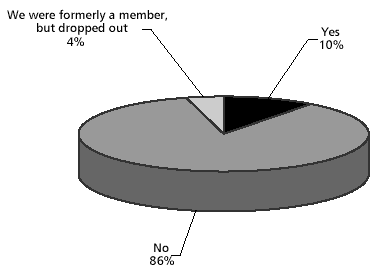 Figure 1 -- Is your company a member of the Object Management Group (OMG)? |
We also asked if our respondents had heard of the MDA. Surprisingly, as Figure 2 shows, 39% answered yes. When you consider how recent the initiative is, and how relatively little publicity it has attracted, we were impressed that the OMG has been much more successful in getting its message across than we might have imagined.
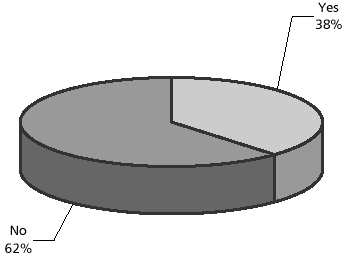 Figure 2 -- Have you heard of the OMG's new Model Driven Architecture (MDA)? |
What really caught our attention was the fact that 39% of the respondents who had heard of MDA were planning on using it on a future company project (see Figure 3). In effect, about 20% of all the companies in our survey are considering experimenting with the OMG's new MDA approach. That's an awfully favorable response to a technology that is really only four months old.
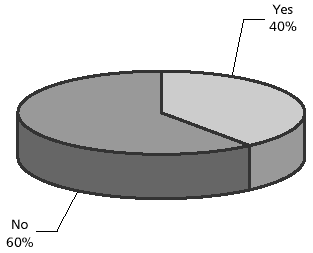 Figure 3 -- Is your company considering using MDA on a future project? |
Of course, companies have been using UML for a number of years, and many companies use technologies derived from UML that are also elements of MDA, including the OMG's Common Warehouse Metamodel and its XML Metadata Interface, so many of the concepts in MDA are hardly new. Although I might have expected OMG members who were closely associated with MDA to experiment in 2002, I would not have expected so many non-OMG members to consider MDA so early. It suggests that companies recognize that MDA answers a real need. It also suggests that existing enterprise application integration solutions are not up to the task and that companies are actively looking for something as comprehensive as MDA.
I submit this same data implies something else. It suggests that the OMG is on the verge of successfully reinventing itself. The OMG has always been about helping companies create and manage distributed systems. Rather than sticking with a single CORBA approach, however, the OMG has had the vision to step back and embrace a new approach that will allow companies not only to use CORBA but also to simultaneously design systems that will support all of the other languages and middleware systems they need to support.
In addition, I suggest the data indicates that companies not previously members of the OMG or those with unrenewed membership will begin to join the new OMG. The OMG is an open systems organization whose standards are created in task forces that meet at technical committee meetings throughout the year. These meetings, which usually include more than 100 representatives from member companies, are where the standards evolve. The OMG is now embarking on an effort to create standards for MDA. It is adding action semantics to UML so that it can support code generation. It is creating profiles that will guarantee that UML can generate and reverse-engineer code for most popular languages and middleware systems. And it is revising industry standards, which it developed in the past, to ensure compatibility with the MDA approach. In effect, by proposing this bold new initiative, the OMG has guaranteed that it will be the place that senior IT executives will want to be to ensure that new OMG MDA standards and methods support the needs of their industries.
The OMG has identified a key technology for the coming decade, as indicated by Figure 3. I suspect that many companies will want to join the OMG to ensure that they have a place at the table as this key new technology evolves and becomes formalized.
1Of the companies surveyed, 28% are from North America, 15% are from Europe, 19% are from India, 9% are from Australia, and the rest are from Asia, Africa, the Middle East, and South America. 16% are companies with revenues of more than US $1 billion, 26% have revenues between $100 million and $500 million, and 57% have revenues of less than $100 million. A little more than 40% of the companies are involved in software development or services, while the rest come from a cross-section of industries.