C++
C++ ("C Plus Plus") is a general-purpose programming language. C++ is regarded as a middle-level language, as it comprises a combination of both high-level and low-level language features. It is a statically typed, free-form, multi-paradigm, compiled language where compilation creates machine code for the target machine hardware, supports procedural programming, data abstraction, object-oriented programming, and generic programming.
-

Distributed Systems Architecture by Arno Puder, Kay Romer, Frank Pilhofer ISBN-13: 9781558606487
• Provides a comprehensive look at the architecture and design of middleware—the bridge that connects distributed software applications
• Includes a complete, commercial-quality open source middleware system written in C++
• Describes the theory of the middleware standard CORBA as well as how to implement a design using open source techniques -
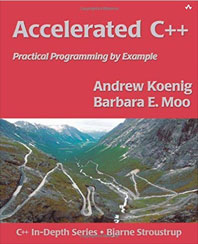
Accelerated C++: Practical Programming by Example (C++ In-Depth Series) (Paperback) by Andrew Koenig and Barbara E. Moo ISBN: 020170353X
After a tour of basic C++, the book looks at more advanced C++ features, such as templates, including built-in support for containers. Besides tapping the strength of Standard C++, you also will learn to design with your own templates. (Other tutorials would defer this material until later on.) The authors have tested the approach in the book in their own teaching, and honed a set of worthwhile examples that will help anyone get familiar with these powerful language features. All examples make use of the command line and console (without GUI programs), but the advantage is that this code should run on any of today's operating systems and compilers. Later sections cover the basics of class design, which include good coverage of operator overloading and inheritance. -
Advanced CORBA(R) Programming with C++ (Addison-Wesley Professional Computing Series) (Paperback) by Michi Henning and Steve Vinoski ISBN: 0201379279
Written for the experienced C++ developer facing real-world CORBA for the first time, Advanced CORBA Programming with C++ is a useful guide to today's most popular standard for distributed computing. -
C++ Primer Plus (5th Edition) (Paperback) by Stephen Prata ISBN: 0672326973
If you are new to C++ programming, C++ Primer Plus, Fifth Edition is a friendly and easy-to-use self-study guide. You will cover the latest and most useful language enhancements, the Standard Template Library and ways to streamline object-oriented programming with C++. This guide also illustrates how to handle input and output, make programs perform repetitive tasks, manipulate data, hide information, use functions and build flexible, easily modifiable programs. C++ Primer Plus, Fifth Edition makes learning and using important object-oriented programming concepts understandable. Choose this classic to learn the fundamentals and more of C++ programming. -
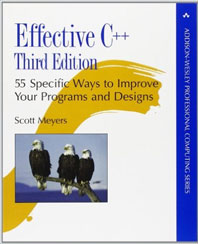
Effective C++: 55 Specific Ways to Improve Your Programs and Designs (3rd Edition) (Addison-Wesley Professional Computing Series) (Paperback) by Scott Meyers ISBN: 0321334876
This exceptionally useful text offers Scott Myers's expertise in C++ class design and programming tips. The second edition incorporates recent advances to C++ included in the ISO standard, including namespaces and built-in template classes, and is required reading for any working C++ developer. The book opens with some hints for porting code from C to C++ and then moves on to the proper use of the new and delete operators in C++ for more robust memory management. The text then proceeds to class design, including the proper use of constructors, destructors, and overloaded operator functions for assignment within classes. (These guidelines ensure that you will create custom C++ classes that are fully functional data types, which can be copied and assigned just like built-in C++ classes.) -
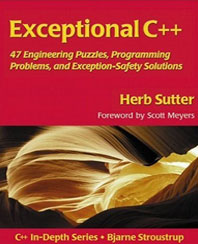
Exceptional C++: 47 Engineering Puzzles, Programming Problems, and Solutions (C++ In-Depth Series)(Paperback) by Herb Sutter ISBN: 0201615622
Based on the author's Guru of the Week Web column, this book poses a series of challenging questions on the inner workings of C++, centering around generic programming with the Standard Template Library (STL), exception handling, memory management, and class design. Even if you think you know C++ well, most of these problems will teach you something more about the language and how to write more robust classes that are "exception safe" (meaning they don't throw any handled exceptions or leak resources). Don't think this is just "language lawyering," though. The author's explanations stress sound programming principles (favoring simplicity) and idioms (such as the Pimpl idiom for class design that promotes faster compile times and better maintainability, or using "smart" auto_ptrs with STL.) Judging from the range and depth of these examples, Sutter's command of the inner workings of C++ is impressive, and he does an excellent job of conveying this expertise without jargon or a lot of theory. -
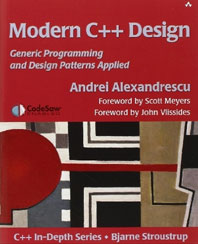
Modern C++ Design: Generic Programming and Design Patterns Applied (C++ In-Depth Series)(Paperback) by Andrei Alexandreseu ISBN: 0201704315
A text introducing the concept of generic components within all C++ language. Discusses issues that C++ developers deal with on a daily basis, including policy-based design for flexibility, partial template specialization, type lists, patterns, and multi-method engineers. -
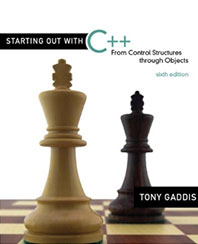
Starting Out with C++: From Control Structures through Objects 96th Edition)(Paperback) by Tony Gaddis ISBN: 0321545885
This text covers control structures, functions, arrays, and pointers before objects and classes. As with all Gaddis texts, clear and easy-to-read code listings, concise and practical real-world examples, and an abundance of exercises appear in every chapter. Introduction to Computers and Programming; Introduction to C++; Expressions and Interactivity; Making Decisions; Looping; Functions; Arrays; Searching and Sorting Arrays; Pointers; Characters, Strings, and the string Class; Structured Data; Advanced File Operations; Introduction to Classes; More About Classes; Inheritance, Polymorphism, and Virtual Functions; Exceptions, Templates, and the Standard Template Library (STL); Linked Lists; Stacks and Queues; Recursion; Binary Trees. For all readers interested in C++ programming. -
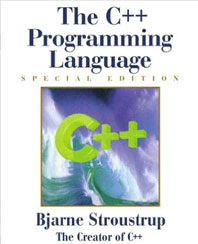
The C++ Programming Language: Special Edition (3rd Edition) (Hardcover) by Bjarne Stroustrup ISBN: 0201700735
Past readers will find that the new edition has changed a great deal and grown considerably to encompass new language features, particularly run-time type identification, namespaces, and the standard library. At the same time, readers will recognize the lucid style and sensible advice that made previous editions so readable and enjoyable. Probably the biggest change is a substantial new section, well over 200 pages in length, covering the contents and design of the C++ standard library, the most important new feature of the C++ specification. The author has also added a substantial number of new exercises while keeping many from previous editions that have retained their value.
*Texts researched through Amazon.com